Before discussing my concept of the proper double haul, I must explain a few important fundamentals of fly casting.
Fundamental I. All casting strokes are divided into two parts: a relatively long motion in which the rod is gradually accelerated and an ending motion with a much shorter and faster speed-up-and-stop of the tip. The speed-up-and-stop is often referred to as a power stroke. Of course, it isn't a power stroke at all; it is a speed stroke. So I call it a speed stroke.
Fundamental II. The shorter the distance the rod tip travels during the speed-up-and-stop, the tighter the loop will be.
Fundamental III. The faster the rod tip accelerates over that final short distance of the speed-up-and-stop and the quicker it stops, the faster the line will travel.
Fundamental IV. Once the line straightens, it begins to fall. The line obtains distance by unrolling. When it has completely unrolled, it will go no farther.
Fundamental V. Line control is the most important element of good casting. You must prevent slack from entering the system during the cast.
You can observe these fundamentals by conducting your own interesting experiment with just four casts.
1. Make several false casts, then sweep the rod forward near the end of the casting stroke in a relatively long speed-up-and-stop and you will see the line develop a large loop.
2. Make another cast, but this time make a much shorter stroke at the end of the casting stroke. Watch as the line forms a tighter loop.
3. Make another cast with a short stroke (to form a small loop) but during the speed-up-and-stop, move the rod tip rather slowly and don't stop quickly. You will see a small loop form, but it will not go far.
4. Finally, make another cast, but this time, move very rapidly over that short distance at the end of the cast and make the rod tip stop as abruptly as possible. Watch as the line forms into a small, tight loop. The swiftness of the stroke and abruptness of the stop causes the line to travel much farther.
It is vital to understand that the more swiftly the rod tip moves through that very short final distance and the quicker the stop, the tighter the loop and the farther the cast will unroll before it begins to fall. A tight loop made with a quick stop directs more energy toward the target. If you understand these three factors, you can see why a single or double haul permits you to make longer casts.




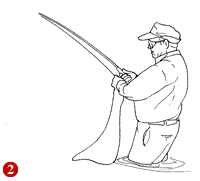
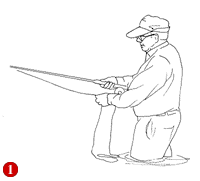 The rod tip should start low and stay low on longer casts. Note that both hands are close together at the start.
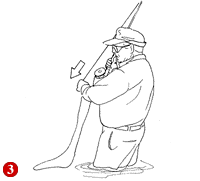
  As the rod rises and loads, your line-hand follows your rod-hand and they are kept the same distance apart.
  The haul is short (inches) and hardly noticeable. Compare the distance between steps 2 and 3.
 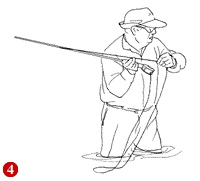 The forward cast begins and your rod-hand and line-hand stay at equal distance apart until the haul is made during the speed-up-and-stop.
  The short haul is made with both hands stopping at the same time.
 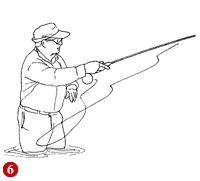 As soon as both hands stop, the line can be released or controlled as it shoots to the target.